Moisturizer for dry skin: how to choose in 2026


You bought a cream at the pharmacy. You applied it in the morning. By noon, the skin is pulling again, and by evening, redness flares around the nose. Sound familiar? It isn’t your skin. It’s a formulation that solves one problem and ignores two others. Here’s the guide to stop buying the wrong things.
Dry skin isn’t one condition
Most people say “dry” when they mean “dehydrated.” They aren’t the same. Dry skin lacks oil and lipids in the barrier. Dehydrated skin has enough oil, but little water. The treatment is different. If you buy a moist cream, but the real issue is missing oil, the water in that cream will simply evaporate and leave the barrier even drier than before.
The test is simple: in the morning, before you wash, look in the mirror. If the skin is matte and tight, it’s dry. If it shines but feels tight a few hours after applying cream, it’s dehydrated. Most women past thirty have both.
Three ingredient groups to recognize
Humectants. The ones that pull water in
Glycerin, hyaluronic acid, urea, panthenol. On their own, they’re not enough. A humectant without an occlusive will draw water from the deeper layers of the skin up into the air. Your skin feels better for half an hour, then worse than before.
Emollients. The ones that fill the barrier
Plant oils, squalane, ceramides, shea butter. They fill the empty spaces between cells, smooth texture, restore softness. For dry skin, they are the heart of the formulation.
Occlusives. The ones that lock moisture in
Waxes, shea butter, lanolin. They form a film that stops water from escaping. Modern formulations prefer lighter occlusives, like shea or light waxes, to avoid a heavy feel.
A good cream for dry skin has to carry all three groups. You’re not just buying hydration. You’re buying hydration, barrier repair, and lock-in, all at once.
What to avoid on the label
Read the first five ingredients. Eighty percent of the formulation lives there. If you see:
- Alcohol Denat. or SD Alcohol in the top five, put the cream back. It dries skin out
- mineral oil as the main emollient. It’s not dangerous, but it feeds nothing, it just sits there
- fragrance in the top three spots. Irritation is a matter of days
- glycerin with no emollient behind it. A humectant alone, without protection
What to look for on the label
If you see these in the top half of the INCI list, the formulation is serious:
- argan, i.e. Argania Spinosa Kernel Oil. A nourishing emollient with vitamin E
- Opuntia Ficus-Indica Seed Oil. The strongest plant source of linoleic acid
- Butyrospermum Parkii. Shea butter for occlusion
- Ceramide NP or Phytosphingosine. Repair the barrier directly
- niacinamide. Reduces water loss through the barrier
Our AFOULKI cream is built exactly on this principle. The first ingredients aren’t water and glycerin, they’re argan, prickly pear, and shea. Humectants are there, but they’re held in by emollients and gentle occlusives. The result is skin that doesn’t tighten right after application, and is still soft at midday.
Pharmacy vs. authentic care
Pharmacy creams for dry skin usually carry around thirty ingredients, of which maybe eight are active. The rest are emulsifiers, preservatives, and stabilizers. The formulation is safe, but generic.
AFOULKI has 22 ingredients, and 14 of them are active plant work. Shorter list, higher concentration of actives. That’s the small-batch approach, from Moroccan cooperatives rather than industrial lines.
Routine, not just cream
The best cream on dry skin that’s just been washed with a sulfate cleanser is only half the solution. The cleanser sets the starting point. If the cleanser breaks down the barrier, the cream half an hour later is doing emergency repair, not maintenance.
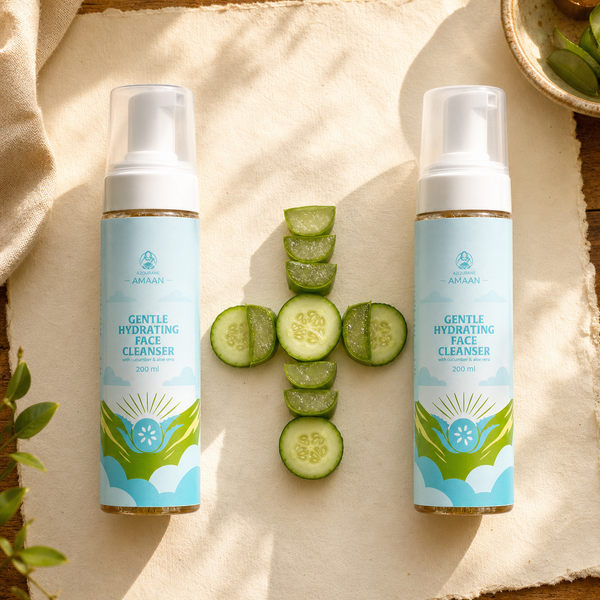
That’s why the Face Duo goes in pairs. AMAAN cleanser is a gentle, sulfate-free gel with glycerin and aloe vera; it doesn’t foam aggressively and leaves the barrier intact. Then AFOULKI cream does what it’s supposed to: feeds and shields.
One thing we often skip
Moisturizer works better on damp skin. Apply it within 60 seconds of washing, while the skin is still slightly wet. Water becomes part of the formulation, the emulsion traps that moisture into the skin. A dry cream on dry skin is a recipe for something that glides, but doesn’t penetrate.
Bottom line
For dry skin you’re not buying just a cream, but a combination of humectant, emollient, and occlusive. If the top five ingredients on the label don’t cover all three groups, the cream won’t hold. Whether it’s a Sarajevo winter or a seaside summer, the principle is the same.
The Face Duo is our answer to that math. See the pair. 80 KM, free shipping within Bosnia, 30-day support.
