Guide · Ingredients

Argan oil for the face in Bosnia: how to choose, use, where to buy.

Everything you need to know about real argan oil for the face. First-hand, from people who have worked with women's cooperatives in Morocco for generations. No marketing stories. No generic internet advice.

What argan oil is and where it comes from

Argan oil is pressed from the kernels inside the fruit of the Argania spinosa tree, which grows in only one region of the world: southwest Morocco, an area called Souss-Massa. The tree lives up to 200 years. Its roots sink twenty metres deep in search of water. It tolerates temperatures above 50 degrees Celsius. It does not grow anywhere else on the planet.

Because of that geographic limit, every drop of real argan oil in the world comes from the same region. The traditional knowledge of how to process it is carried by women in Berber cooperatives who have kept the recipe for generations. UNESCO added that knowledge to the Representative List of Intangible Cultural Heritage of Humanity in 2014.

The gap between cheap "argan" oils and real argan oil is wide. Real oil is:

  • 100% pure, no additives, no fragrance, no dilution with cheaper carrier oils
  • Cold-pressed (not hot-pressed; hot-pressed oil is for cooking, not skin)
  • Light gold to amber in colour
  • Mildly nutty in smell, never strong or rancid
  • From the Souss-Massa region, ideally from a women's cooperative

Why argan oil works so well on the face

The composition of argan oil is rare in the plant world:

  • 80% unsaturated fatty acids · omega-6 (linoleic acid) and omega-9 (oleic acid). These rebuild the skin's lipid barrier, which holds water inside the skin and blocks irritants from outside.
  • Vitamin E (tocopherols) · the most powerful plant-derived antioxidant. Tocopherols neutralise the free radicals that drive oxidative stress and accelerated ageing.
  • Squalene and phytosterols · natural molecules that calm irritation and support elasticity.

Because of this composition, argan oil works effectively for:

  • Dry and dehydrated skin · locks in water, prevents transepidermal water loss
  • Mature skin · vitamin E plus squalene restore elasticity
  • Sensitive skin · non-irritating, non-comedogenic, calms redness
  • Acne-prone skin · oleic acid helps regulate sebum production (patch test first)

One thing worth knowing: argan oil works BEST on slightly damp skin, not fully dry skin. Damp skin absorbs the oil better, and the oil locks that moisture in. Dry face, oil sitting on the surface, far less effective. That is the mistake most people make.

How to use argan oil for the face: 5 steps

  1. Wash your faceCleanse thoroughly with a gentle cleanser. Leave the skin slightly damp, not fully dry.
  2. Warm the oil in your palmPlace 2 to 3 drops onto a clean palm. Press the palms together and rub gently for 3 to 5 seconds so the oil warms up.
  3. Press into damp skinTap the oil over the whole face and neck. Tapping, not rubbing. Damp skin absorbs the oil better.
  4. Wait 60 secondsGive the oil a minute to settle before adding moisturiser or makeup. No need to wipe or pat dry.
  5. Layer with moisturiserIf you use a moisturiser (for example AFOULKI), put it on top of the oil, not under. The oil locks in water from the cream.

For very dry skin in winter you can layer: oil, cream, oil again. For oily skin, start with 2 drops, 2 to 3 times a week, not every day.

How to spot real argan oil

The Bosnian market is full of products that say "argan" while containing 1 to 2% argan diluted in cheaper plant oils (sunflower, soy, palm). Here is how to recognise the real thing:

1. The ingredient list

Real oil has one single ingredient: Argania Spinosa Kernel Oil. If there are other oils listed, it is a blend, not 100% argan.

2. The colour

Light gold to amber. Transparent like water means diluted. Dark brown means oxidised or culinary grade (roasted, not suitable for facial use).

3. The smell

Mildly nutty, like a lightly toasted hazelnut. Never strong, never rancid. If it smells like perfume, a synthetic fragrance has been added.

4. The origin

"Made in Morocco" plus "Souss-Massa region" plus ideally "from a women's cooperative". If it only says "Moroccan-inspired" or is manufactured in France or Spain, it is not from the source.

5. The price

Real 100% argan oil at 30 ml costs at least 35 to 45 BAM in Bosnia. Anything below 20 BAM is 99% diluted or fake.

2014 UNESCO protected
600+ Families in Bosnia
100% Cold-pressed, one ingredient

Where to buy argan oil for the face in Bosnia

Argan is the centrepiece of our line. Three options by strength and use:

100% pure form

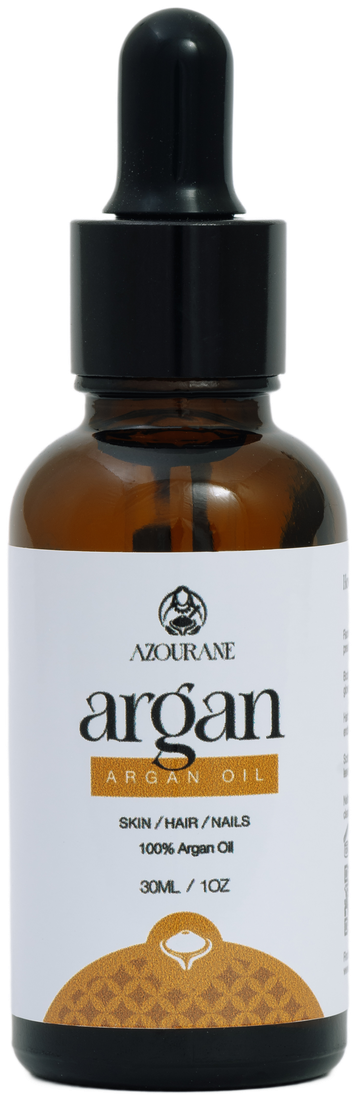
100% Argan Oil, 30 ml Coming · June 2026

Cold-pressed, one ingredient, direct from women's cooperatives in Souss-Massa. The next batch lands in June 2026. Join the waitlist and we'll let you know.

Join the waitlist →

Argan in a cream

AFOULKI Moisturiser with Argan In stock

50 g cream pairing argan oil with the AQUAXYL complex. Holds water all day. Built for dry and mature skin. 55 BAM.

See AFOULKI →

Argan in a cleanser

AMAAN Gentle Hydrating Cleanser In stock

200 ml cleanser with trace argan, the AQUAXYL complex, and aloe vera. pH 5.5, sulphate-free. The first step of any Moroccan routine. 30 BAM.

See AMAAN →

Gift set

AMAAN Duo · 2 bottles, free shipping In stock

Two AMAAN cleansers for 60 BAM. Good as a gift or to stock up. Free shipping across Bosnia and Herzegovina.

See AMAAN Duo →
Start the argan routine

You do not have to wait for the 100% oil to come back in June.

The AMAAN cleanser and the AFOULKI cream both carry argan oil from the same women's cooperatives in Souss-Massa. Start the routine now, add the 100% oil when it returns.

Order AMAAN Duo · 60 BAM, free shipping

Frequently asked questions

What argan oil is best for the face?

100% cold-pressed, cosmetic grade (not culinary), from the first harvest. Colour should be light gold to amber, smell mildly nutty. If the smell is strong or the colour very dark, the oil is oxidised or culinary grade. Verify origin: real argan oil grows only in southwest Morocco, the Souss-Massa region. AZOURANE argan oil comes from women's cooperatives in that region, whose knowledge was added to the UNESCO list of intangible cultural heritage in 2014.

Will argan oil clog pores?

Argan oil is non-comedogenic, meaning it does not clog pores or cause acne for most people. For skin prone to strong acne, do a patch test behind the ear 24 hours before applying to the face.

How often should I use argan oil on the face?

For most skin types, once daily in the evening is enough. Dry skin can tolerate consistently. Oily skin: start with 2 to 3 times a week and increase if the skin reacts well.

Can argan oil replace my face cream?

For dry skin it can replace cream short-term. Long term we recommend combining both: oil for lipid-barrier protection, cream for water-based hydration. See our AFOULKI moisturiser, which contains argan oil plus the AQUAXYL complex for water binding.

What is the difference between argan oil and prickly pear oil?

Argan is pressed from the kernels of the Argania spinosa fruit. Prickly pear is pressed from the seeds of the Opuntia ficus-indica cactus. Argan is higher in omega-6 and omega-9 fatty acids. Prickly pear has a higher concentration of vitamin E. Argan rebuilds the lipid layer. Prickly pear works on elasticity. The AZOURANE line uses both: argan in the AFOULKI cream, prickly pear in the upcoming soaps and toners.

Is AZOURANE argan oil safe for sensitive skin?

Yes. 100% pure, no fragrance, no additives. For highly reactive skin still do a patch test behind the ear 24 hours before first facial use. If you notice redness or itching, stop use and consult a dermatologist.

When will it be back in stock?

The new batch of 100% argan oil arrives in June 2026, directly from women's cooperatives in Souss-Massa. Sign up on the product page waitlist and we'll let you know the moment it lands.

Where is it made and where does it come from?

The ingredient (pure argan oil) comes from women's cooperatives in southwest Morocco, the Souss-Massa region. Packaging and quality control are done by labs in Morocco. We import the finished product into Sarajevo and ship across Bosnia and Herzegovina. Our story explains the full chain.

About AZOURANE

AZOURANE is a Moroccan-Bosnian cosmetics brand. We manufacture in Morocco, in women's cooperatives across the Souss-Massa region. We import the finished products into Sarajevo, where we run a shop inside SCC (Vrbanja 1, 3rd floor). We deliver across Bosnia and Herzegovina, with cash-on-delivery payment. Founded by Hussam Aitelqadi, a Moroccan-Bosnian entrepreneur.

More in Our Story and on the Ingredients page.